
I often find myself asking the same question, whether it’s about business, public life, or the people close to me – Trust vs Verification. Recently, commenting on a post on X, I asked this question. At what point do you move on from someone who keeps sidestepping and ignoring your valid questions? This was related to a political post but can apply to every area of our lives.
The Joonko story made me ask a related question closer to home. When is it appropriate to set aside blind trust in a business partner so the facts can be verified?
The Story / Context – What Happened
Joonko Diversity Inc., founded in 2016, was an AI company. Joonko Diversity Inc. built its platform to help employers identify and hire diverse candidates to meet their DEI goals. As a promising startup, it raised about $27M from investors in funding rounds in 2021 and 2022, based on its growth story, its customer base, and its future potential.
However, all was not well with the Joonko story.
To win investors, its founder claimed Joonko had more than 100 customers, including Fortune 500 companies. The founder shared glowing testimonials from well-known brands and claimed over $1M in revenue. However, the real numbers were a fraction of that, and the testimonials were fabricated.
In mid-2023, one investor grew suspicious and asked for documents to verify Joonko’s performance. The founder followed with a series of documents meant to reassure them. But they didn’t settle the doubts.
First came a forged bank statement showing an average balance of more than $5M, when the actual balance was millions lower. Then came purchase orders from supposed top-brand customers. Many were fictitious, carried forged signatures, using company names that had no relationship with Joonko at all.
When the investor and the board pressed further, the truth came out. The founder admitted to lying about Joonko’s revenue, customers, and bank balances.
In June 2024, the SEC charged her with defrauding investors of at least $21M, and federal prosecutors filed parallel criminal charges. The company went bankrupt. In September 2026, she pleaded guilty to securities fraud and now faces up to 20 years in prison. Sentencing is still pending.
That’s the gist of what happened. But as I said at the outset, this story is worth looking at through the lens of trust vs verification. Here is another story (Frank, the finance company) that I examined from a different lens but is relevant for the core message of this article.
Should we start with trust and verify later? Or should trust be built over time, through a transparent process of verification?
I have come to a clear answer. And let me share how I got there.
My Interpretation / Experience
We often hear from the wise men of business – “Trust is fundamental to business.” And I agree.
But do we act on that wisely when the partner is a close family member, a close friend, someone with charisma, or someone who holds more power in the relationship?
Most of us hesitate to ask for verification. We start with blind trust instead.
That’s what I did in 2015, in my first business. My partner was a friend of over 20 years, like family to me. At least, so I thought. He also held more power in our friendship. He came with experience in business, people, and politics, and I had none of that at the time.
The business was a partnership with him and [his wife], who together ran the day-to-day operations while I stayed involved remotely.
Asking him for proof never crossed my mind. The closest I came was early on, when I suggested we keep two sets of accounting statements: a summary view, and a detailed view at the transaction level. He pushed back on the detailed one. I wondered about it for a short while, and then it faded from my mind.
Over the next five years, the only full view I had of our finances came once a year. At tax time, I pulled together downloaded bank statements into a year-end view for our filing. My partners never shared the details, but I began to notice a pattern. The Excel sheets showed a loss every single year, five years in a row. The explanation was always the same: margins were thin, and small additional expenses tipped us into the red. I took that answer as proof.
What I didn’t see then was that I had not verified anything. And even if I had wanted to, I didn’t know how to verify, or even how to ask given the dynamics of the relation.
That’s what stayed with me about Joonko. The investor did the right thing. They asked. But why did it take so long to ask?
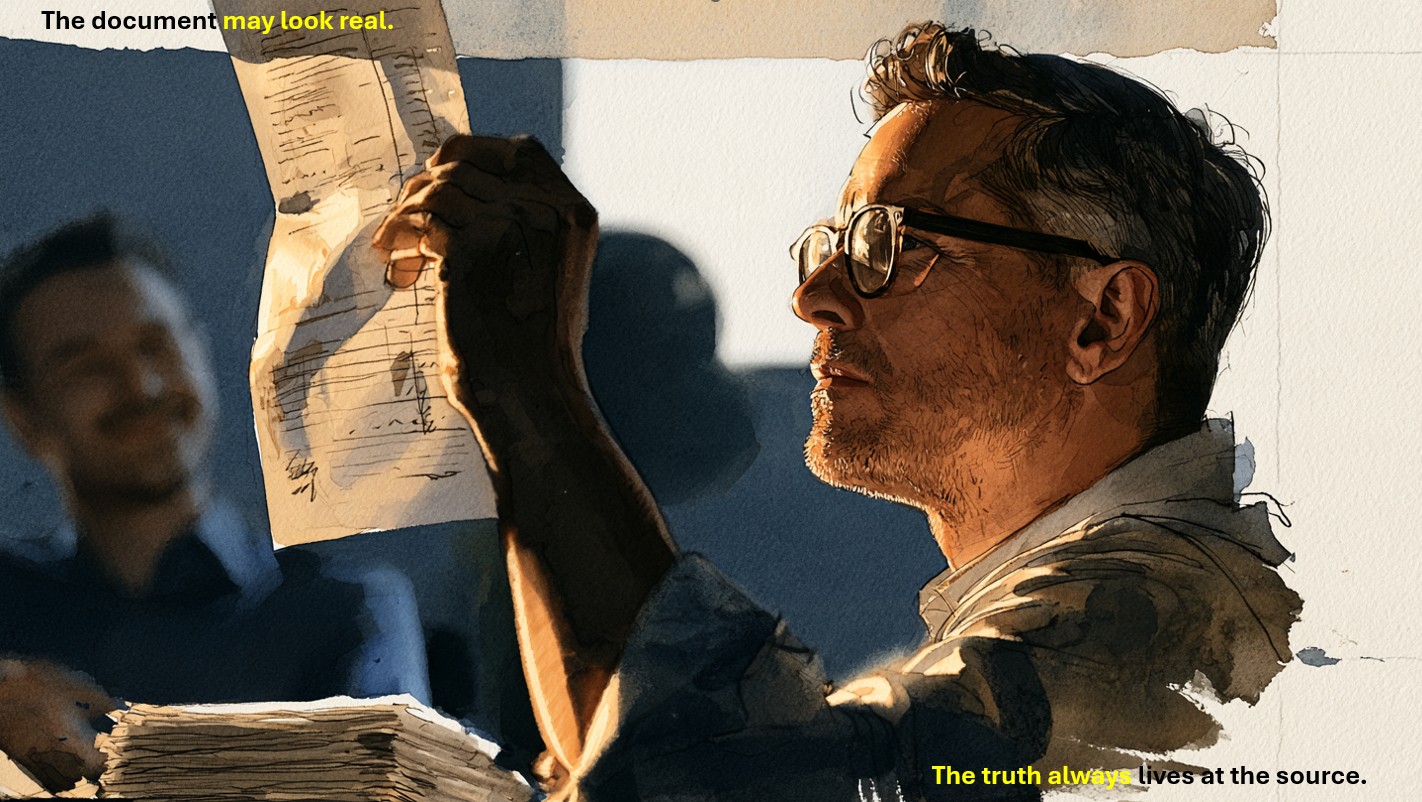
And when they did, the proof came from the very person whose story was being questioned. A bank statement feels like evidence. It has a logo, numbers, and a date, all of which can be made to look authentic. But if it passes through the hands of the person you are checking on, you have not verified the facts, only the document.
Real verification goes to the source: the bank, the customer, the supplier.
So here is what I have realized.Trust should be earned through verification, and once earned, verification keeps it honest. Trust is what lets you keep verifying without it feeling like an accusation. They are not opposites. They reinforce each other.
The Lesson: What Can You Learn and Do Differently?
1. Trust the person. Verify the facts.
These are not contradictory. As the old saying goes, “Trust, but verify.” Verification is the bridge between trusting someone and knowing what’s true.
A healthy partnership can withstand reasonable checks. If someone responds with “You don’t trust me?”, bring the conversation back to the business. The question isn’t whether you trust them. It’s whether the business has a way for both of you to know what’s true.
So what do you do if repeated requests are brushed aside? That is the time to make a call, even if it’s a hard one. Stay in the partnership, or step away and recover whatever share of your investment you can.
Be prepared: such partners rarely intend to make you whole. In my case, all I was left with was a BIG HOLE. 🙁
2. Don’t let one person control both the transaction and the proof
Small businesses can’t afford elaborate controls, but simple ones go a long way. If one partner manages the finances, the other should have direct access to the bank records, not just the reports. If one person owns the key customer relationships, someone else should confirm the major accounts now and then. This isn’t distrust. It’s a mature business.
I shared my own dilemma earlier: five straight years in the red, and no idea how to ask my partners to let me verify the finances. They held the bank account and handled day-to-day operations, since I was remote. So I never had a real view of the daily cash register closing: how cash received could be misused, how personal expenses could be woven into daily purchases, or the other clever ways of paying yourself without calling it that. 😉
3. When reasonable questions meet unreasonable resistance, get curious
Resistance doesn’t prove fraud. There can be good reasons for delays or confidentiality. But if simple questions keep producing changing explanations, more documents, and less access, stop asking “What’s the explanation?” and start asking “How can I verify this at the source?”
For me, that moment came the day my suggestion of a detailed statement was pushed back. I just didn’t recognize it then.
4. Closeness, charisma, or growth are never reasons to stop checking
Joonko’s investors wanted to believe a growth story. I wanted to believe in a friend. The pull is the same: the more we want something to be true, the less we check. The bigger the stake, the more verification matters.
Borrowed Wisdom: The Buddha told the Kalamas not to accept something because of who says it, how it’s presented, or tradition, but to test it for themselves. Going to the source is an old idea.
Final Thought: The Choice
The Joonko story isn’t really about one founder or one startup. It asks something ordinary of all of us: how much of what I believe about my business have I verified at the source, and how much rests on what someone I trust has told me?
The answer isn’t zero trust. That would make business impossible. But the warning sign often isn’t the fraud itself. It’s the moment the explanation stops making sense, and whether we have the courage to go looking for the truth at its source.
What would you do if you reached that moment in your own business?