
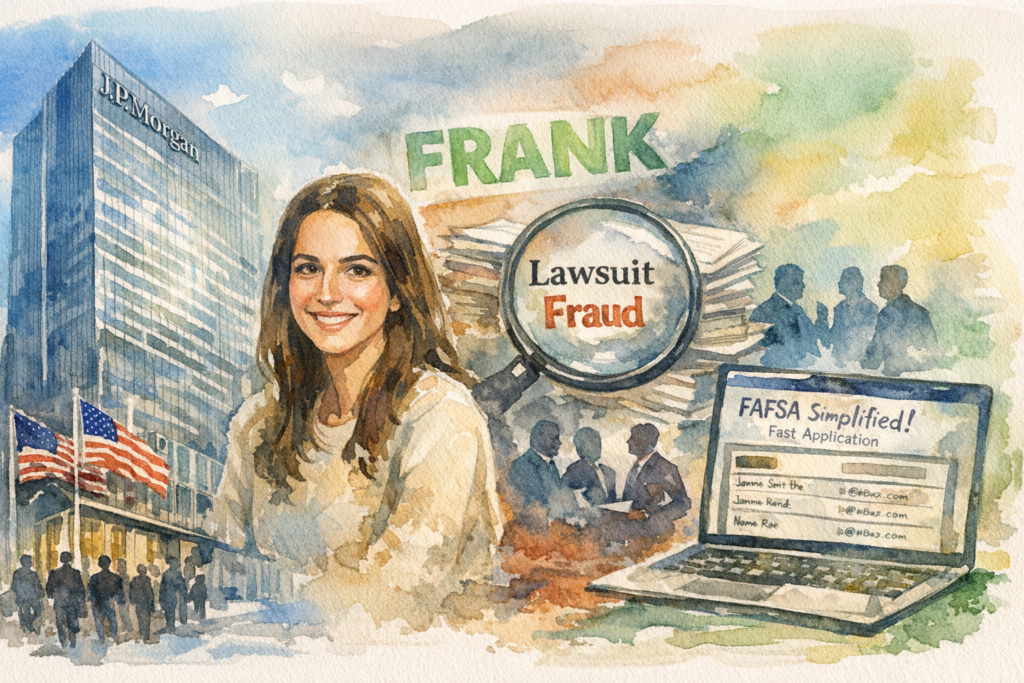
The Story – What Happened
The NY Times broke a story in January 2023 that stopped me mid-scroll. JP Morgan Chase – one of the most powerful financial institutions on the planet – was suing a startup founder, claiming she had conned them out of $175 million. 😊
Charlie Javice, founder of Frank, an education finance planning service. She started the company in 2016 to help students navigate financial aid applications. In September 2021, JPMorgan acquired Frank. By January 2023, they were in court alleging fraud.
I am not here to say who is right or wrong – the law will take its course, and the truth will come out. Or will it? How this case settles will also reveal a lot about how fraud plays out when big players are involved.
But the NY Times story alone is already full of lessons. So, let’s get into it.
The Interpretation – What I Noticed
On Charlie Javice: She is a hustler. And I mean that in the most observational way possible. The ability to convert ideas into visible products, to move fast, to get people to believe — that is a rare skill. Whether there was a solid product foundation behind Frank remains to be seen (now we know there wasn’t). Her earlier venture in 2013 seemed more concept than company, yet it gained traction. I suspect her smooth, fast-talking, energetic nature had a lot to do with that. Nothing is wrong with that.
Here is the thing about hustlers – I have been up close with one. My ex-business partner, who later turned out to be a fraud, was a brilliant hustler (perhaps skills gained from politics early in his life). I was in awe of his energy, his ability to sell a room, his confidence (later revealed as a cover for his own insecurities). I brought the hard skills – documentation, structure, the detail work. He brought the hustle and charm. And because I was so dazzled by what he could do, I stopped questioning what he was actually doing. That was my mistake.
Hustlers make great partners, right up until they don’t. The skill that makes them magnetic is the same skill that can be used to obscure the truth.
None of Frank’s business partners seemed to have questioned her claims over five years – except one data engineer who raised a flag.
Did Javice listen? Or did she make the data fit her narrative? We know how that part of the story goes.
In my own experience, when I finally started standing up for my values – asking harder questions, demanding accountability around finances, accounting, partnership – the truth began revealing itself. It was not pretty. But it was necessary.
On JP Morgan: How does one of the largest banks in the world get conned on a $175 million deal?
First – I must laugh. Wait, I am still laughing😂😂. Ok. I am back.
The questions that come to mind are uncomfortable ones:
What did their due diligence actually look like? Did anyone cross-check the user numbers? Who was responsible for background checks on the people running the business? Was it the wrong incentives — bonuses tied to deal value — that pushed analysts to recommend the acquisition?
I have no sympathy for large institutions that claim to fight for truth when it suits them. Think of every financial crisis and the role such large institutions play. But JPM needs to do what is right for their business here, and I will be curiously watching.
An army of overpaid analysts is still no guarantee of sound decisions. If anything, it creates a false sense of security.
The Lesson – What Can You Learn and Do Differently
Three patterns run through this story. I have seen them before. You will see them too again. Watch out for these telltale signs.
1. The Hustler’s charm is also their warning sign.
Flashy personalities and big visions are easy to fall for – I know because I did. Pay attention not just to what a hustler says, but to how they respond when questioned. Do they answer directly? Do they get defensive? Do their words and actions line up over time? How someone reacts to honest scrutiny tells you more than any pitch deck ever will.
A pattern always emerges.
2. Vision without values is just a story.
Selling a vision is essential in business – but it must be anchored in integrity, transparency, and accountability. These are not soft ideals. They are the infrastructure of any real partnership.
When I did not insist on memorializing the shared vision and terms with my partner in writing, I left myself exposed.
Running purely on trust, without structures that reflect shared values, can and will come back to bite you.
3. Do your diligence on the people, not just the business.
Numbers can be manufactured. Models can be dressed up. But character leaves traces – in how people communicate, how they handle pressure, in how they treat those who question them.
For smaller operators and entrepreneurs, there is no margin for error here. You cannot afford a $175 million lesson.
Do not let FOMO drive your decisions. Take the time to look at who you are really dealing with — and stay alert to patterns. When something feels off, resist the urge to explain it away. As Maya Angelou put it, when someone shows you who they are, believe them the first time.
———————————————————
Update on the case: Read here